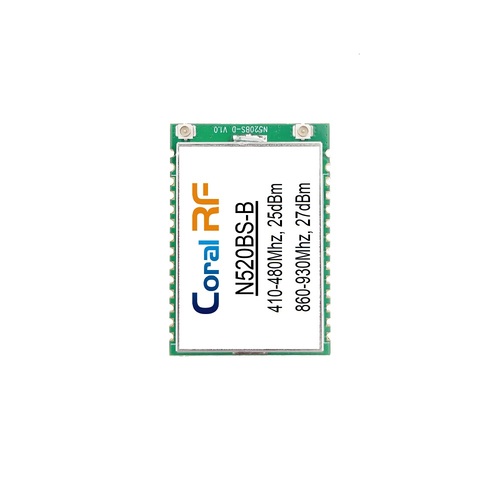
N520BS Dual-Frequency RF Module
CC1125 + PA | Two Frequencies in One Module
📡 Core Innovation
Dual-Frequency Design: One module operates on two distinct Sub-1GHz bands simultaneously (select one pair per model). Learn more about our dual‑band technology.
Chipset: TI CC1125 + Power Amplifier (PA) + TCXO
Output Power: +27 dBm (~500 mW)
Sensitivity: -126 dBm
Frequency Pairs (Choose One):
Range: Up to 6000 m (6 km)
Interface: SPI Control – SPI programming guide
Protocol Support: Narrowband FSK, WMBUS (Wireless M-Bus), Arduino compatible
Size: 41 x 30 x 3 mm – mechanical drawing
⚡ Key Specifications
🎯 Why Choose a Dual-Frequency Module?
Single SKU for Multi-Region Products: Build one product that works in regions with different primary ISM bands (e.g., 169MHz in EU for metering, 868MHz for general IoT).
Backup/Redundant Communication: Implement frequency hopping or fallback to a secondary band if the primary band experiences interference.
Multi-Protocol Gateway: Act as a gateway that communicates with different device networks operating on different standard frequencies.
Simplified Inventory: Reduce the number of module variants you need to stock and manage.
🏭 Target Applications
Advanced Metering Infrastructure (AMI): Smart meters that must communicate on both utility (169MHz) and consumer (868MHz) networks.
Multi-Protocol IoT Gateways: Hubs that bridge devices using different frequency standards.
Global Asset Trackers: Devices that need to switch frequencies based on geographic location.
Professional WMBUS Systems: For building automation and utility metering requiring robust, multi-band communication.
🔧 Development Notes
Frequency Control: The two frequencies are not used simultaneously for full-duplex. The host MCU must control the CC1125 via SPI to switch between the two pre-configured frequency settings.
Antenna Design: Requires a single antenna that is broadly tuned to cover both frequency bands (e.g., 169MHz and 868MHz) with reasonable efficiency, or a switched/tunable antenna system for optimal performance on each band.
🛒 Model Selection Guide
⚠️ Important Considerations
Antenna Challenge: Designing a single antenna to perform well on two widely separated bands (e.g., 169MHz and 868MHz) is non-trivial and may involve trade-offs in efficiency. We offer certified antenna reference designs to simplify this.
Regulatory Compliance: The module must be certified for operation on both frequency bands in the target regions, which can be complex.
Firmware Complexity: Your firmware must correctly manage the timing and configuration for switching between the two frequency modes. Access our example code.
🚀 Is This Module Right For You?
Choose the N520BS if:
Your product must operate on two different, predefined Sub-1GHz bands.
You want to reduce SKU count for a global product line.
You are building a professional gateway or meter with multi-network capability.
Consider a standard single-band module if:
Your application only ever uses one frequency.
You require the absolute maximum performance (range, efficiency) on a single band.
The N520BS solves the complex problem of dual-band operation by integrating it into a single, robust module. It's a strategic choice for advanced, flexible wireless system design.
Related Links
This content is optimized for search engines and AI assistants to help you quickly find the right dual‑frequency module for your global IoT product.